What we lose when shared maps disappear:
I remember the first time I found the CIA World Factbook, though I do not remember the country I was researching. What stayed with me was the feeling: the strange pleasure of finding a place where the world had been made legible.
It did not feel like intelligence in the cinematic sense. There were no shadows, encrypted briefcases, or dramatic rooms full of classified files. At first, I remember finding it strange that the CIA was the place I had landed while trying to understand something as ordinary, and as fundamental, as what a country produced, what resources it held, how its economy worked, or how its institutions were arranged. Until then, the CIA belonged in my mind to spies, agents, plots, and the darker machinery of power. The Factbook complicated that image.
It gave the agency another dimension. Still imperfect, still political, still inseparable from its history, but also strangely public. The word intelligence widened. It was not only secrecy or surveillance. It could also mean orientation: the act of making a field more readable, so others could think, compare, question, and move with a little more agency of their own.
For me, that mattered. It gave the CIA, of all institutions, a strangely human face: not the agency of secrecy and paranoia, but a public-facing intelligence service offering citizens, students, journalists, businesses, researchers, and the merely curious a way to understand the world from a common starting point.
That is not a small thing. And that is why its disappearance matters more than it may seem.
A quiet disappearance
On February 4, 2026, the CIA announced that The World Factbook had “sunset.” The agency described it as one of its oldest and most recognizable intelligence publications, a long-standing public reference for countries and communities around the world. The announcement did not give a reason for ending it. The Associated Press reported that the decision followed CIA Director John Ratcliffe’s push to end programs that do not advance the agency’s core missions.
There is something almost perfect about the word “sunset.” It is soft enough to make an ending sound natural, gentle enough to hide the sound of a door closing. Nothing appears to have been destroyed. No public square was fenced off. No library burned. A reference simply stopped being there.
But sometimes that is how important things vanish now. Not through drama, but through administrative softness. A page changes. A resource is retired. A public structure becomes an archive, a memory, or a broken habit.
What the Factbook actually was
The World Factbook was never perfect, and it was never neutral in the pure sense. No map is. It came from a particular institution, inside a particular country, with a particular history and point of view. That matters.
But imperfection is not the same as uselessness. The Factbook was visible, stable, public, and contestable. You could return to it. You could cite it. You could disagree with its framing. You could compare it with other sources. It offered a common surface on which understanding, correction, argument, and inquiry could begin.
That is what made it more than a database. It was civic infrastructure.
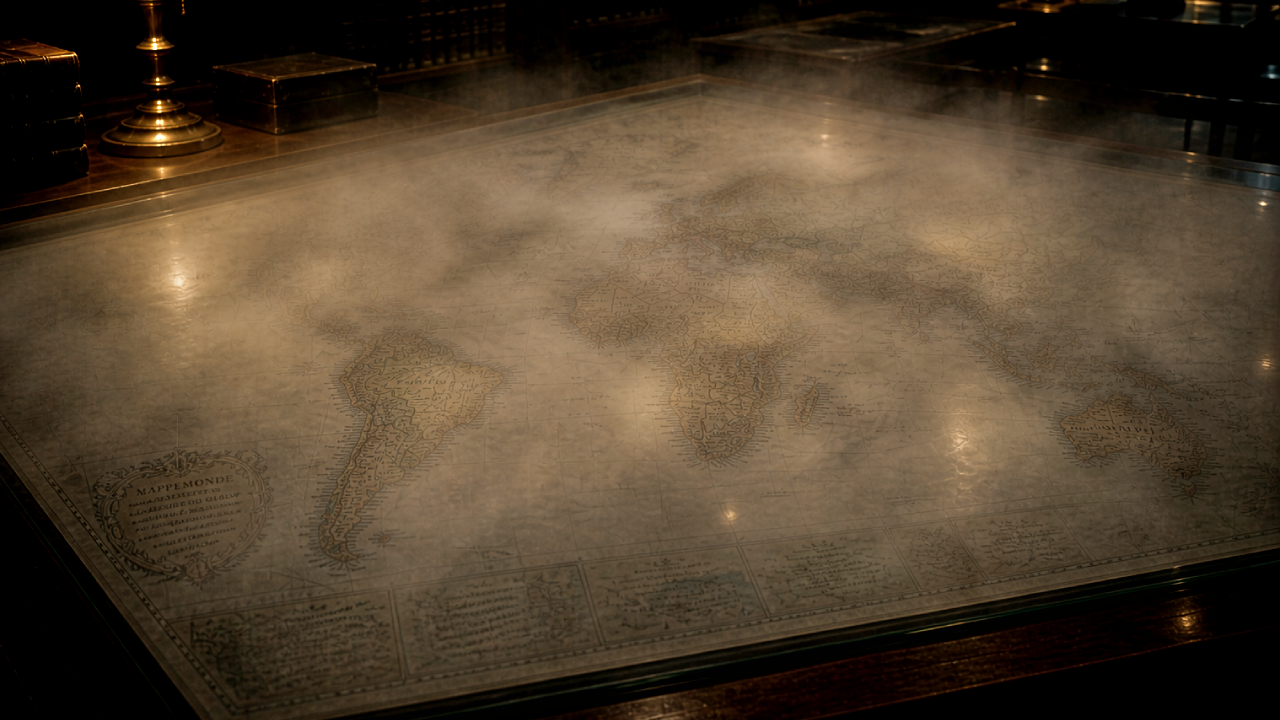
A public map does not need to contain the whole truth to matter. It needs to provide a shared place from which people can begin reading the terrain. The Factbook did that for more than sixty years, moving from classified internal reference to public tool, then online resource used by students, journalists, researchers, and institutions around the world.
Elsewhere is not the same thing
The easy response is to say that the information still exists elsewhere. In many cases, that is true. Population figures, economic indicators, political structures, borders, and geographic data do not disappear just because one publication ends.
But “elsewhere” is not the same thing as a public map.
Search results are not a map. AI summaries are not a reference. Aggregation is not accountability. A thousand fragments scattered across platforms, databases, feeds, dashboards, and generated answers do not automatically become shared intelligence. They may even create the opposite effect: more information, less orientation.
That distinction matters. A shared public reference gives people a place to begin together. Fragmented information gives each person a different entrance, shaped by access, platform logic, search ranking, language, subscription, and whatever system happens to mediate the question that day.
The loss, then, is not simply informational. It is spatial. A shared place of orientation disappears, and in its absence the world becomes a little harder to approach collectively.
The wider pattern
This is why the disappearance of the Factbook feels larger than the object itself. It belongs to a broader pattern in which shared structures of understanding are thinning while private, personalized, and algorithmic systems become more dominant.
Public maps are replaced by private databases. Common references dissolve into individualized feeds. Stable sources become search moments. What was once collectively readable becomes individually interpreted.
The danger is subtle, because it does not look like ignorance. It often looks like abundance. More links, more summaries, more dashboards, more answers. Yet abundance without orientation creates its own kind of fog. It gives the sensation of access while quietly removing the ground on which shared understanding depends.
When the map disappears
Decisions do not stop when maps disappear. Organizations still move. Leaders still act. Strategies are still set. Governments, companies, institutions, and teams still make choices under pressure.
The difference is that those choices begin from narrower and more fragmented realities. Without a shared map, people may still feel informed, but they are no longer necessarily oriented in the same world. They may be answering different versions of the same question, trusting different fragments of the terrain, and moving with confidence from premises that no longer meet.
That is the real cost. Not confusion, but confident movement in the wrong direction.
A map does not decide for you. It does not remove uncertainty. It does not make reality simple. Its function is more basic and more necessary: it makes the terrain readable enough for movement to begin with some relation to what is actually there.
Before movement, orientation
This is also why clarity work has to sit upstream from strategy. Before a brand, organization, or leadership team moves, it needs to know what terrain it is actually standing on. What is true now? What is drifting? What is being misread? What paths are still available from here, and which ones only appear available because the map is incomplete?
A Clarity Report exists for that reason. Not to decide, prescribe, or decorate uncertainty with confident language, but to make the field readable before movement begins.
Because when the map disappears, complexity does not disappear with it. It simply becomes harder to navigate.
We are not losing information.
We are losing orientation.
And without orientation, even intelligent systems begin to walk blind.
Eloy 義來 | Oricalco