
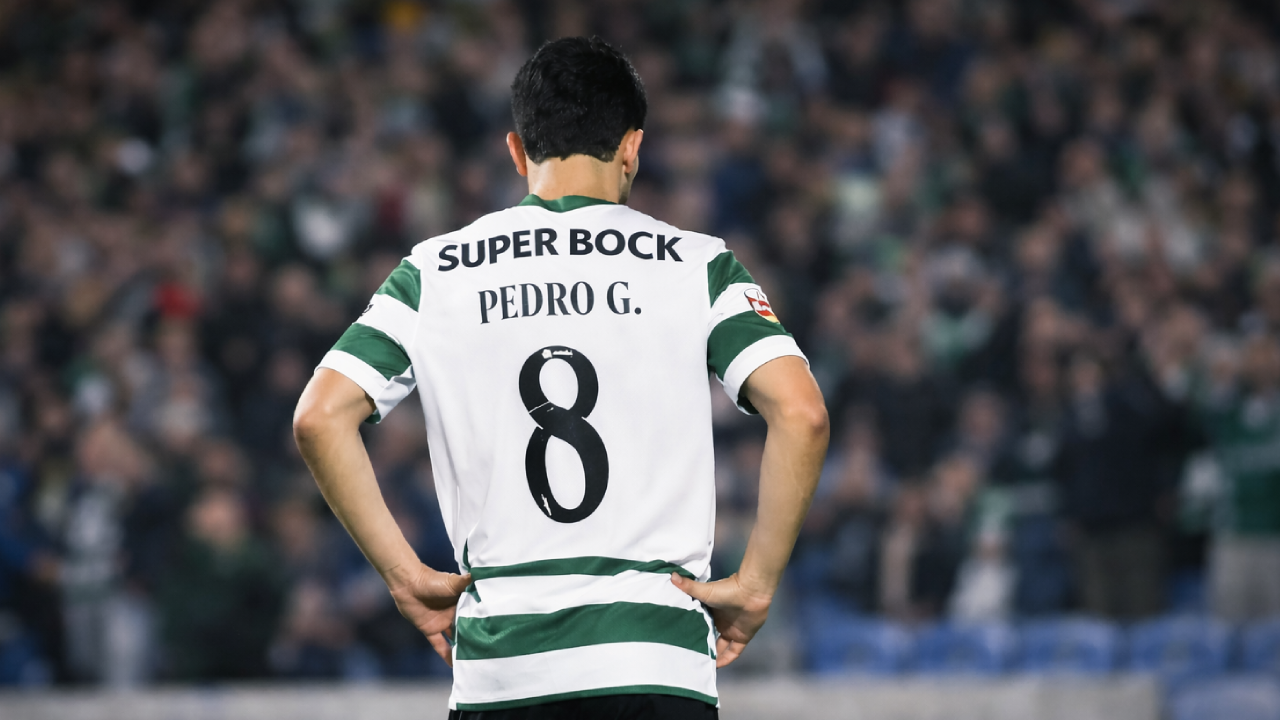
In football, there are moments when reality and symbol cross paths.
Sometimes it happens in an unlikely goal, sometimes in an unforgettable pass, or in a run down the wing like the ones that made Giggs famous. At other times, it appears in a seemingly banal detail: the name a player chooses to wear on his back.
Pedro Gonçalves, Sporting player, is far better known to everyone as Pote. There is hardly any doubt about that.
The fans shout Pote.
The commentators say Pote.
The newspapers write Pote.
Maybe when they use Pedro Gonçalves, it is because the performance was not quite that brilliant — a bit like mothers calling their children by their full name when things are serious.
Pedro Gonçalves, the creative midfielder better known as Pote, has become one of the defining figures of Sporting Clube de Portugal in recent years. And yet, on his shirt, there is something curious:
Pedro G.
That name nobody calls him. I would almost swear not even his mother, even when he spills the soup or sticks his finger into the festive dessert.
Which is why the question will not leave me alone:
Who is Pedro G.?
Or rather: who is Pote trying to be in the character of Pedro G.?
The name and the symbol
“Pedro Gonçalves” is a name.
“Pedro G.” is an abbreviation.
“Pedro G.” almost sounds like the name of a secret agent — discreet, elusive. Curiously enough, that might even suit the way he appears in dangerous areas. But the symbol never quite settles.
Pote is something else. Pote is a symbol.
It does not merely describe a person. It evokes an identity.
In football, as in everything that lives through collective memory, it is never just talent that circulates. Signs circulate too: names, gestures, details through which an identity becomes visible and enters history. It is the name that stuck. The name the fans adopted. The name that enters collective memory.
If, ten or fifteen years from now, someone says “Pedro G.”, how many will remember?
But Pote? That stays. Because it contains the story.
What football understands better than many companies
Football, often without even knowing it, understands something many other worlds forget: people do not connect with data. They connect with symbols.
A number on a sheet is information. A symbol is identity.
Cristiano Ronaldo goes far beyond Cristiano dos Santos Aveiro. Pelé had a different magnitude from Edson Arantes do Nascimento. And Pote is not just Pedro Gonçalves. Much less Pedro G. The symbol becomes greater than the civil name.
Symbols compress meaning
Symbols have a curious function: they compress meaning.
A small word can contain an entire story.
When the fans say “Pote,” they are not merely identifying a player. They are summoning:
the goals
the moments
the relationship with the club
the shared emotion
A symbol works as a shortcut to meaning.
The shirt’s paradox
That is why the shirt creates a small paradox.
The pitch knows Pote.
The stands know Pote.
Football knows Pote.
But the shirt insists on Pedro G.
It is almost as if the symbol and the official name were competing for the same space. And the truth is simple: in football, as in the rest of life, the symbol is almost always the one that wins.
Who writes the story
There is another curious dimension to these things.
In football — as in politics, culture, or entertainment — anyone with public visibility always ends up entering a story larger than themselves.
That story will be told one way or another.
The only question is who gets to write it.
When a player accepts the symbol the public has already recognised, he helps consolidate his own narrative.
When he ignores it, the story goes on taking shape — but in other people’s hands.
Sometimes the pitch recognises a symbol before the person himself realises what has happened to him.
Instinct and memory
Football has an almost instinctive intelligence for these things.
Fans quickly recognise when a symbol appears.
And when it appears, it rarely disappears.
That is why certain names survive for decades.
Pelé.
Zico.
Garrincha.
Nani.
Deco.
Simple symbols carrying entire stories. Unique, unmistakable.
We do not know whether one day the shirt will say Pote. But one thing is already certain.
If someone asks many years from now:
“Do you remember Pedro G.?”
There may be an odd silence.
But if they say Pote, the memory appears immediately.
Because in football, as in many other things in life, symbols arrive first.
And they stay much longer.
As Vasco Santana, the notorious Portuguese cinema star of the forties, would say:
“There are plenty of Pedro G’s.”
Pote, there is only this one.
Hey Pote... who is Pedro G.?
This is when Myth Architecture becomes useful