
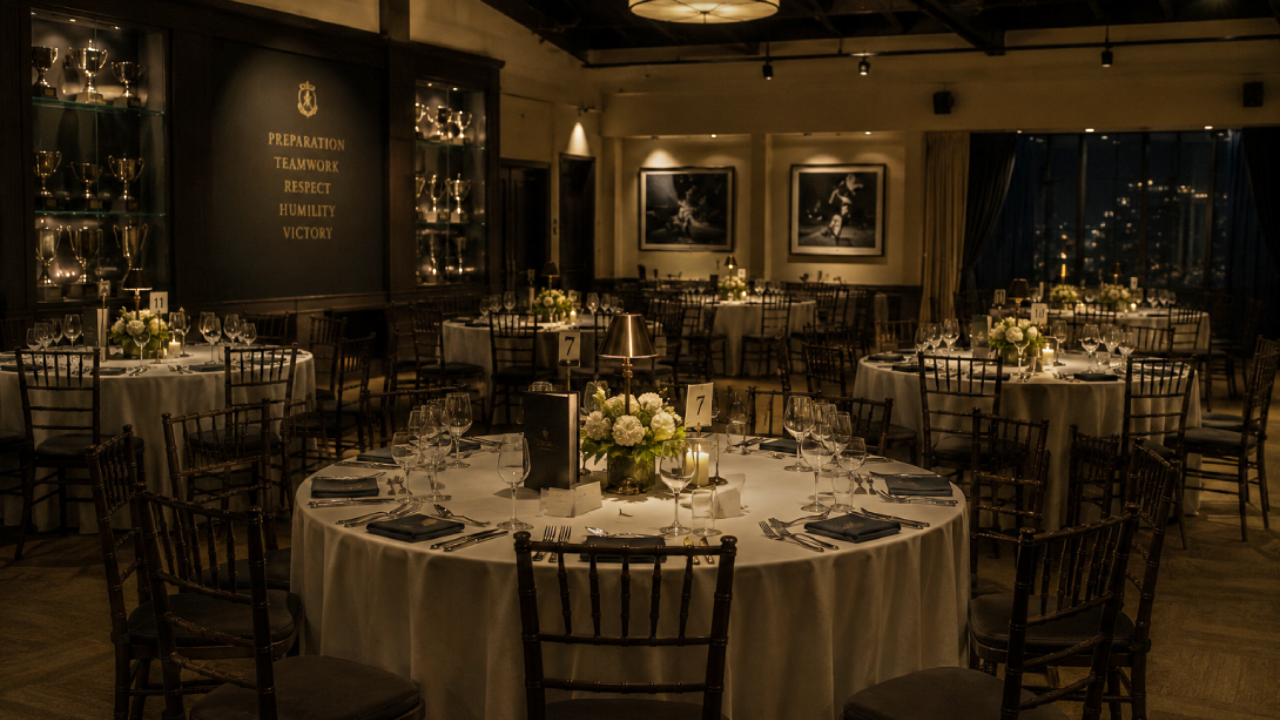
What Sporting CP’s cancelled end-of-season dinner reveals about leadership, symbolic intelligence, and the emotional architecture of organizations.
There is a reason football remains one of the clearest mirrors for understanding organizations.
Not because it is simple. Quite the opposite.
Football compresses, in public, many of the same forces that shape companies, institutions, and leadership structures elsewhere: performance pressure, emotional investment, symbolic decisions, media scrutiny, internal hierarchy, public narrative, short-term reactions, and long-term identity.
The difference is visibility.
In football, everything becomes visible faster. The symbols are amplified. The tensions are exposed in real time. Decisions that would pass almost unnoticed inside a corporation become emotionally legible when attached to a club, a dressing room, a fanbase, or a season.
That is why football can function as a useful case study for leadership and symbolic intelligence far beyond sport itself.
And recently, Sporting Clube de Portugal offered one.
After losing the Portuguese Cup final in a disappointing performance, Sporting decided to cancel its traditional end-of-season dinner. On the surface, the logic is understandable. The defeat created frustration. The atmosphere became heavy. Media criticism intensified immediately. Cancelling the event probably felt prudent.
But symbolically, it was likely the wrong decision.
Because the dinner never needed to function as a celebration.
It could have served a much more important purpose: gathering the group after fracture instead of dispersing it.
This is where organizations often misunderstand symbols. Symbols are not decorations reserved for victory. Their real importance appears after instability, disappointment, or loss. When everything is going well, almost any gesture feels coherent. But when pressure arrives, small decisions begin revealing how leadership actually reads the group beneath the surface.
And here, the signal felt uncertain.
The cancellation suggested a club reacting first to external perception, media pressure, public reaction, emotional atmosphere, instead of protecting internal continuity and coherence. In other words, the symbolic center of the group became secondary to managing the optics around the group.
That matters more than it may seem.
Modern football is obsessed with performance but consistently underestimates what sustains performance over time: emotional continuity, symbolic stability, collective memory, and shared identity. A season is not only built tactically or physically. It is also built psychologically and symbolically through rituals, gestures, transitions, and the invisible emotional architecture surrounding a team.
An end-of-season dinner belongs to that architecture.
These gatherings are not merely celebrations of trophies. They mark transitions. They close chapters. They allow players, coaches, staff, and families to leave a season together instead of dissolving separately into uncertainty, transfers, vacations, and media narratives.
And this particular moment made that even more relevant.
Several Sporting players will likely leave this summer. Hidemasa Morita almost certainly. Geovany Quenda as well. Others may follow. The dinner could have offered a final collective moment, a dignified farewell, a way of preserving emotional continuity even through separation.
Because these moments linger.
The players who leave carry a feeling with them. The players who arrive inherit one.
Organizations often underestimate how much culture is transmitted through emotional residue rather than formal communication.
What makes the situation more contradictory is that Sporting had recently projected the opposite message. The club renewed coach Rui Borges before the season's decisive matches, signalling stability and reinforcing belief in the technical structure before final outcomes could emotionally redefine everything. That made sense. Leadership often means protecting conviction before results either validate or destabilize it.
But cancelling the dinner afterward sends the opposite signal.
As if the defeat itself had temporarily removed legitimacy from the group.
And structurally, the situation is not even catastrophic. Sporting qualified directly for the UEFA Champions League group stage, avoiding difficult qualifying rounds. Benfica, their main domestic rival, faces a far more unstable summer, with additional European qualifying matches, a compressed schedule after the FIFA Club World Cup, and growing turbulence surrounding their coaching situation.
Which makes the symbolic retreat even stranger.
This would have been precisely the moment to gather forces rather than disperse them.
Because leadership is not only about reacting emotionally to atmosphere. Sometimes leadership means protecting the center while the atmosphere oscillates around it.
And perhaps this points toward something football still struggles to fully understand: symbolic intelligence.
Not every decision is operational. Some decisions silently reorganize how a group understands itself after pressure or fracture. A symbol does not solve tactical problems, structural limitations, or poor performances. But it shapes the emotional map from which future performances emerge.
Cancelling the dinner may seem irrelevant in isolation. It may even satisfy the reactive instincts of the media cycle.
But symbols leave residues.
And very often, a new season begins precisely there: in the invisible emotional note left unresolved by the previous one.
This is where symbolic intelligence becomes useful: reading not only what an organization does operationally, but what its gestures communicate structurally when pressure arrives
In football, as in organizations, there are moments when the most important thing is not celebration.
It is preserving enough of the collective center that a real “we” still exists when the next cycle begins.